Minjung Theology in the Anthropocene: Toward a Planetary Minjung Ecumenism
Hiheon Kim
Dean, Hanshin Graduate School of Theology
Introduction
This essay discusses minjung theology, formed against the backdrop of the suffering and struggle of the Korean minjung, in the context of the Anthropocene crisis. The study explores ways to reactivate liberation praxis amid ecological and intellectual crises by broadening the scope of minjung theology to include a planetary perspective. Furthermore, it engages in dialogue with ‘public theology’, which is rooted in the tradition of liberation theology. The issue of theological-practical ‘publicness’ is deeply embedded in minjung theology too, making public theology an excellent interlocutor for minjung theology. However, as minjung theology is a political theology that originated in Asia and differs from public theology in its social context, the character and practical orientation of the two theologies may be incompatible. For this reason alone, pursuing a creative dialogue between them is highly significant.
The present paper is divided into three sections. First, it introduces the fundamental characteristics of minjung theology as they were established at its inception, as well as the practical concerns and philosophical framework that have been expanded over the past 50 years through the experiences of the Korean minjung movement and dialogue with other theologies. It will then outline the hermeneutical features of minjung theology that bear witness to the ‘experience of suffering bodies’ and provide a theoretical basis for dialogue with public theology. Secondly, this paper will analyze theological conditions that enable ‘transversal dialogue’ by interpreting the challenges of the Anthropocene from the perspective of minjung theology, and discuss the ‘subjectivity’ of the transformative subject that makes minjung ecumenism possible. Finally, the paper will initiate a dialogue between minjung theology and public theology, proposing ‘planetary Minjung ecumenism’ as an Anthropocene minjung public theology.
1. A Brief History of Minjung Theology
1) The Origin and Fundamental Concerns
Minjung Theology is an Asian contextual theology formed through theological reflection on the painful experience of the Korean minjung. It may be a theological ‘fruit’ born of the memory of the long suffering and struggle of the Korean minjung rather than a ‘creation’ of Korean theology. Ahn Byung-Mu confesses that the root of his minjung theology “can be traced back to the experiences he underwent during the Japanese colonial period and in Manchuria,” and that “his bone-deep experience of the minjung’s lived reality flowered theologically under the Yushin military regime in the 1970s.”[1] Minjung Theology began from reflections on the ‘collective suffering’ inscribed in the bodies of minjung, suffering from such Asian coloniality as colonialism and war, division and massacre, military fascism and ideological confrontation. It also signified the appropriation of the liberation tradition in minjung movement. In order to overcome various patterns of domination that continue to operate even after the end of the colonial rule, namely the ‘coloniality of power,’ insofar as it remains inscribed in labor and power, knowledge production, and subject formation, the Korean minjung movement has ceaselessly resisted and struggled toward ‘de-colonialist world-making.’[2] Such a minjung tradition brought about a transformation of the concept, minjung, itself.
As the research of Kang In-cheol has shown in detail, the term ‘minjung’ has been used in Korea for some two thousand years, and its meaning has not been fixed but changed historically.[3] It was during the 1920s, when the anti-colonial movement began in earnest, that the concept of minjung in Korean society broke away from its existing passive meaning as a ‘dependent and oppressed mass’ and acquired the transformative meanings of ‘resistance and subject.’ In the Korean theological field, there had already been a modicum of response to this change.[4] However, it was in the 1970s that minjung theology began to articulate its own theological formation. Because there was a crucial need for a theological witness to the suffering of minjung symbolically manifested in the Tae-il Jeon’s self-immolation incident, criticism began against the traditional theology that ignored the minjung phenomena and simply equated Christianization with westernization. The development of this post-Western Korean theology was a fundamental search for the genuine meaning of the Gospel that could bear witness to the experience of the suffering minjung.
Minjung theology sought to overcome two problems of Western traditional theology.[5] First, it developed theological reflections on the ‘supernaturalist’ idea of revelation. When the church in Korea was isolated in its own ghetto with religious exclusivism, creative minorities sought to resolve the difficulties made of the dualistic worldview. They sought to cultivate an integral spirituality according to which the Christian faith does not conflict with the universal experience of humankind, and the love of God must unfold across diverse religious traditions and cultures. This subjective search for a Korean theology began in the 1960s. Second, a politico-theological critique emerged in response to the traditional theology in that the prosperity of the European society was not a gift bestowed upon Christian civilization by God, but the sacrifice of the social catastrophes in the Third World. In particular, Asian theologies began to criticize Western theologies that had turned Jesus’ teaching into the triumphalist ideology of the dominators by reflecting on the historical fact that Christian theology represented imperial oppression in the post-World War II struggles for national liberation. It was through the convergence of these two critical reflections that minjung theology was born.
Over time, various theoretical streams and conceptual developments have emerged from minjung theology. However, its fundamental character remains unchanged: it is grounded in the minjung event, which is ‘embodied’ onto the suffering body, rather than theoretical abstraction. In other words, minjung theology is a ‘theology of body(soma)’ that attends to the body of Christ embodied in the minjung event.[6] The fact that minjung theology shifted the focus of theology to the reality of the suffering body is an attempt to recover anew the meaning of salvation and liberation in the Asian context. Drawing on the diversity and inclusiveness of Asian religiosity, minjung theology depicted the self-redemption of minjung and the vicarious redemption of Christ as a non-dualistic relation. It also intensified the praxis of liberation by embedding politico-theological critique within the depth of religious spirituality. In minjung theology, religious spirituality and the practical task of minjung liberation are inseparable. Paradoxically, the ‘contextualization’ of theology in the Asian context signifies a thorough search for and fidelity to the ‘origin of the gospel.’ In this context, ‘the origin of the gospel’ is used to denote the gospel of Jesus, which becomes apparent once Westernized theological ideology is removed. When seeking the true meaning of the Christian gospel within Asian religious traditions and socio-political conditions, minjung theology is given rigorous thought. It is an exploration of how the love of God, embodied through Christ — the ‘Christ-event’ that is the origin of the gospel — is reflected in the minjung event.
2) Minjung Hermeneutics
Ahn Byung-Mu characterized the distinctive ideas of minjung theology as a “hermeneutical revolution in the process of the theological exodus” from traditional Western theologies. He summarizes the main features of minjung hermeneutics as follows: first, to make a shift in perspective from reading God’s revelation in heaven to reading it in the context of historical suffering; second, to pay attention to the dynamic movement of life and the event-character of all things; third, to overcome the subject–object schema and theological dualism, which are the ideological roots of exclusivism and othering; and fourth, to reaffirm collectivity that discloses the organic interrelatedness of all things.[7]
Kim Kyung-jae understood this theological methodology of minjung theology as tertium quid beyond all dichotomies. In a 1976 essay, he coined the term “Mahayana Christianity” to describe minjung theology, viewing the salvation of individuals and the liberation of all life as an organic whole. Furthermore, he described it as “Korean Zen-Christianity,” in which the reality of life is realized and witnessed through holistic bodily practice.[8] The Mahayana Christianity is a way of thinking that seeks to dispel the distortion of Christian ideas caused by exclusivism and literalism, and to reveal the ‘infinite possibilities and openness’ of salvation and liberation across the vast expanse of history and the cosmos.
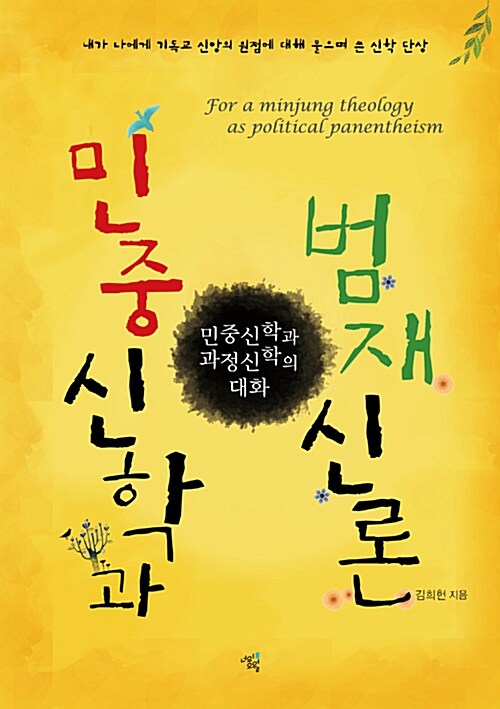
The ‘Mahayana’ nature of minjung theology is evident in both its theological worldview and its practical orientation. Its theological foundation is panentheism, which uses Eastern relational thinking to reconstruct a cosmological ontology while moving away from substantialism — the philosophical root of all dualism.[9] Minjung theology shares a political praxis of liberation with the decolonialist minjung movement of Korea. As a practical ecumenism, it seeks salvation and liberation not in individual rights, but in ‘responding to the suffering of others’, thereby sharing a spirituality with secular society and neighbor religions. Minjung theology refers to this as “messianic politics” and distinguishes it from “political messianism,” which instrumentalizes the minjung. It does this by practicing a liberative politics that subjectivizes minjung and responds to the suffering of others.[10] Therefore, one might describe minjung theology, which combines these philosophical features and political characteristics, as a form of “political panentheism.”[11]
Unlike transcendental deism or immanent pantheism, political panentheism understands the relationship between God and the world as a dynamic intercarnation, a paradoxical relationship of non-duality. Rather than being a heavenly monarch who exerts unilateral causality from outside the world, God is immanent within all things and resonates with the suffering of creation. God’s creation and salvation are realized through events in historical reality. Consequently, the deepest valley of creation, the place of creaturely suffering and groaning, is precisely where God participates most deeply. Human self-liberation in history and God’s creation of all things are joined through an evental confluence, forming the basis of an ecological ontology concerning the salvation of all life, beyond human social liberation. Political panentheism enables minjung theology to portray the Kingdom of God (basileia) as a ‘community of cosmic love’, where God, humanity, and the world are interconnected through the rhythm of life. This theological worldview encourages a communal spirituality, where one’s own salvation is not separate from the liberation of others.
Over the past fifty years, since the emergence of minjung theology, there have been social changes and challenges. Minjung theology has evolved in response to them. The major challenges it has faced include the limits of bourgeois politics, the structural inequalities of the neoliberalist order, the growth of political populism combined with religious fundamentalism, the fragmented relativism of postmodernity, the nihilistic revolt of the post-truth era, and finally the emergence of the Anthropocene, representing the techno-totalitarianism and ecological catastrophe of modern civilization. These challenges have brought about changes in minjung discourse and have prompted an expansion of the concept of minjung itself. Since the 1990s, minjung theology, which began in the 1970s as a political-theological ‘discourse of resistance’, has absorbed postmodern ‘discourse of deconstruction’, grappling with questions of diversity, hybridity, and heterogeneity. In the twenty-first century, it is being called upon to respond more deeply to the intensifying social-ecological ‘apocalypse of death’. Kim Yong-bock urged that early minjung theology should expand its “social biography of minjung” to encompass a cosmic horizon, attending to a “zoegraphy” that would restore the dynamic, convivial symbiosis of all things.[12]
Today’s minjung theology seeks to move beyond ‘resistance’ or ‘deconstruction’, creatively synthesizing the theological legacy of the past to establish a new basis for ‘transformative publicness’. While the resistant subject of the past fought to dismantle oppressive hierarchies of domination and the deconstructive subject of postmodernity struggled to dismantle the essentialist violence of modern reason, today’s minjung theology moves beyond sociopolitical functionalism. It focuses on a theology of the ‘expanded body’, which contemplates the organic relationships between individuals and communities and between humanity and nature. In the Anthropocene era, minjung theology has a mission of transformative solidarity and publicness, restoring the intrinsic value of all things with the ontological resonance.
The ‘suffering body’ is a central concern of minjung theology. A theology of the body on a planetary scale broadens the concept of the suffering body from a social to a cosmic level. The body is an ‘embodied’ reality through which we experience and live in the world; it is not merely a product of discourses composed of signs or concepts. According to Alfred North Whitehead, human recognizes the world in the form of “presentational immediacy,” and this cognition is rooted in a deeper perceiving mode of “causal efficacy,” through which the world affects the human body.[13] Conceptualization and practice are made possible by the body, which is connected to the world.
A realistic understanding of the body in relation to the world overcomes the problem of anthropocentrism created by the Cartesian rational subject, instead calling for the reconstruction of an ecological-spiritual ontology rather than the ontological deconstruction of humanity itself. Humans transcends their own existential finitude to aspire toward a “cosmic community of love” and embraces “spiritual humanism,” which walks the path of liberating salvation while embracing the divinity inherent in all things.[14] Referring to the agent responsible for this as the ‘practicing subject’, minjung theology can be described as a theology that moves beyond resistant and deconstructive subjects to embrace a new, transformative subject, one driven by a spirituality of mutual prosperity that responds to the suffering of others with the belief that the self and the whole are one.
2. Anthropocene Issues from the Perspective of Minjung Theology
1) Anthropocene, Its Meaning for Minjung Theology
The concept of the Anthropocene, first proposed by Paul J. Crutzen and Eugene F. Stoermer, has evolved from a geological term into a potent metaphor encapsulating the defining crisis of our time. Evidence from geology and Earth system science demonstrates that the Anthropocene is not just a psychological crisis for human beings, but a physical deformation of the Earth system itself. Humans are no longer merely external disruptions; they have become “geological subjects” who have entered the engine room of the “planetary machinery” and altered its mode of operation.[15] This judgment—that human activity has become the dominant force disturbing the Earth system—undermines the modern Enlightenment’s binary division between human and nature, and serves as an apocalyptic warning against anthropocentrism.
The Anthropocene is a powerful metaphor and a highly contested concept. As its geological definition and civilizational implications become clearer, minjung theology recognizes the limitations of the discourse. This criticism stems from the realization that further research is required into the actual causes and systems that have triggered the problem. In scientific and technological discourse, the Anthropocene invokes the universal abstraction of anthropos. However, the true culprit behind the earth’s cries is by no means a singular humanity. In fact, history has never been defined by a universal humanity. The chronology of carbon and plastic inscribed in the Earth’s strata reveals a history of colonialist plunder, endless capital accumulation, and the greed of the Global North that drove the destructive process. This reveals that the suffering produced by the Anthropocene is thoroughly asymmetrical. The poorest in the global South, impoverished workers, and non-human creatures, that lack a language of self-defence and are excluded from the benefits of carbon capitalism, bear the cost of climate disaster and ecological collapse first and most severely. Once again, they are the ‘victims of tectonic upheaval’ within the immense geological convulsion that is the Anthropocene.
Accordingly, a group of thinkers who have traced the structure of climate injustice propose that the problem of the Anthropocene should not be understood as the universal fault of humanity as such, but rather as the problem of particular systems and institutions. Ian Angus denounces the “metabolic rift” in which “capital’s time” destroys “nature’s time” within the exploitative order of “fossil capitalism” which is based on fossil fuels.[16] Meanwhile, Jason W. Moore locates the essence of the Anthropocene crisis in a specific system, capitalism, through the alternative designation ‘Capitalocene’. This system has exploited the labor power of the poor and the web of life of nature as “cheap nature” without limit.[17] Furthermore, Donna Haraway critiques the history of the plantation system, which was established for the profit of capital and broke the interdependent system of life through monoculture. She proposes the ‘Chthulucene’ as an alternative world in which human and non-human life are intertwined as kin.[18] In addition, various multilayered discourses have been proposed to diagnose the Anthropocene, all of which testify that today’s crisis is the result of structural injustices involving inequalities of race, nation, class and gender. These critical perspectives do not negate the term ‘Anthropocene’ itself, but rather reveal the complexity of the crisis and the multifaceted nature of potential responses.
The Anthropocene crisis breaks down the boundaries between academic disciplines, calling for a paradigm shift towards interdisciplinarity. Let us begin by introducing two pioneering ideas that offer a comprehensive perspective on this issue. First, Félix Guattari’s concept of “ecosophy” offers a structural approach to understanding the problem of the Anthropocene. Criticizing approaches that are too narrowly focused on climate, ecology and the environment, he proposes a ‘transversal’ mode of thought in which three areas—environmental ecology, social ecology and mental ecology—intersect organically.[19] In order to overcome the error of modernity, which separated nature and culture, one must confront the vast network of exploitation that constitutes the modern age—the “Integrated World Capitalism(IWC),” in which environmental collapse, distortion of social relations, and breakdown of human subjectivity are interconnected. The production of an alternative subjectivity is required in order to navigate these “three ecologies.”[20]
Published in 1972, John B. Cobb Jr.’s book on ecological theology was a pioneering work that addressed the issue as a comprehensive problem in which philosophy, ethics, social criticism and religious spirituality were intertwined. He criticized traditional Western humanism and Christian theology for absolutizing humans and instrumentalizing nature. On the basis of Whiteheadian process philosophy, he argued that human beings are part of nature and that the cosmos as a whole is an organic symbiosis endowed with value and purpose.[21] He argues that overcoming the ecological crisis requires a way of thinking, an ethical approach, and a form of action that can overcome secular materialism and scientific reductionism. He reinterprets the original Gospel of Jesus as the ‘ecological civilization’ required in the age of the climate crisis and proposes “a new Christianity” that returns to the source of the Gospel.
Even before the term ‘Anthropocene’ appeared, Guattari and Cobb offered a multidimensional perspective on the issue. The intersection of the ‘three ecologies’ proposed by Guattari and Cobb’s vision of ‘ecological civilization’ provides minjung theology with ‘transversal ideas’ with which to interpret the asymmetrical suffering of the Anthropocene and seek alternatives. Minjung theology should develop a new theological praxis that resonates with and stands in solidarity with the planetary web of life. The ultimate question facing such alternative efforts is how to redefine the role of humans, given that they are both the culprits who brought about climate catastrophe and the beings responsible for transforming it. A discussion of subjectivity is of the utmost importance.
2) Anthropocene and the Problem of Minjung Subjectivity
The Anthropocene redefines the ontological status of humanity. As Dipesh Chakrabarty has argued, contemporary humanity has acquired a dual status: it acts as a “historical agent” within the ‘global’ networks constructed by modern capitalist civilization and as a “geological agent” that disrupts the ‘planetary’ system through the Great Acceleration—a “doubling of the human.”[22] This duality of the human subject fundamentally challenges the modern Western binary division between nature and culture. This is because industrial civilization has produced results that generate an existential paradox within planetary history that can no longer be controlled by human beings.
The emergence of such a geological subject poses a serious challenge to one of the central tenets of minjung theology, ‘minjung messianism’. Minjung theology holds that “the subject of history is the minjung,” and that the minjung redeem the history of suffering by themselves. In the present day, however, this proposition may be regarded as anthropocentric, and when the political space-time in which people resisted capital and dictatorship collides with the deep time of the Anthropocene, the proposition reaches its limits. Can minjung theology continue the tradition of theological liberation while taking into account not only ‘global’ justice centered on capital distribution, but also the ‘planetary’ limits that constitute the climate crisis?
The first generation of minjung theologians began reflecting on this question a long time ago. In his 1972 essay “Towards an Ecological Ethics,” Suh Nam-dong engaged in dialogue with Teilhard de Chardin. He viewed the world as a ‘web of life’, interpreted the Bible through the lens of Whitehead’s process philosophy and conceptualized ‘God-human-nature’ as an interconnected ecosystem.[23] Kim Yong-bock argued that political subjectivity could not encompass the suffering of the cosmos, and therefore maintained that minjung theology should focus on ‘zoegraphy’. However, this approach has also been criticized for idealizing the organic network of life, thereby weakening the ‘praxis’ and prophetic responsibility of the human minjung. Within minjung theology, the issue of the relationship between criticism of anthropocentrism and subjective responsibility is a key topic in the debate on the Anthropocene.
One of the recent current of thought that criticizes anthropocentrism is new materialism. In order to overcome the modern Cartesian dichotomies of human/nature and subject/object, and to dismantle anthropocentrism, Jane Bennett redefines matter not as passive but as “vibrant matter” that transforms and stirs on its own.[24] She also argues that differences among beings should be “flattened, read horizontally as a juxtaposition,” distributing agency horizontally not only to humans but also to nonhuman creatures, environments, and even thing-systems.[25] This flat ontology brings human beings down from their positions at the summit of being, arranging them alongside climate patterns, plastics, flora and fauna as equal objects and actants.
This concept of ‘distributed agency’ would be a double-edged sword for minjung theology. On the one hand, it encourages practice of symbiotic responsibility within the ecology of things where all creatures are interconnected, moving beyond human subjective guilt. This is because when the vibrancy of things is suppressed by human greed, the consequences are eventually felt by all. Yet, from the perspective of minjung theology, the ontological entanglement of humans and things proposed by Bennett does not address the issue of the asymmetrical responsibility borne by the human subject. The fact that all things possess agency cannot erase the reality that they are placed within exploitative systems. The flat ontology of new materialism and posthumanism, which seeks to deconstruct anthropocentrism, thus presents minjung theology with an ambivalent challenge. On the one hand, its focus on ‘the vitality of matter’ and the dynamic power of ‘agentic assemblages’ that comprise both human actors and nonhuman actants offers important insight for moving beyond anthropocentrism. However, the ontology of distributing agency uniformly across all things carries the paradoxical risk of obscuring the distinctive “transforming agential capacity” and historical responsibility of the capitalist human who has in fact driven the Anthropocene and plundered nature.[26]
Minjung theology cautions against discourses that depoliticize the truth of ecosystems destroyed by climate injustice and the painful experience (han) of the poor. It also considers the transformative subjectivity of the minjung. This transformative dimension is not confined to historical praxis, but also encompasses a cosmic expansion—namely, an interest in the ‘spiritual’ human who becomes aware of the divine presence in everything and embraces a community of cosmic love in walking the path of liberation and salvation. This concern of Minjung theology aligns with the concept of a ‘new anthropocentrism’. Clive Hamilton emphasizes not merely viewing humans as part of nature or as subjects dominating nature, but rather the ‘unique and extraordinary place of humankind’ on this planet and the ‘inescapable’ responsibility that follows from it.[27] Since the Anthropocene is the result of an event in which human history collided with the deep time of the Earth, it is impossible to distribute human agency and responsibility evenly across all things.
In the Anthropocene, humans are both the chief culprits who have destroyed the Earth system and beings endowed with a unique consciousness and capacity to recognize, reflect upon and heal that destruction. As such, humans bear an asymmetrical and significant planetary responsibility unlike that of other actant. While the Anthropocene is a ‘scientific’ fact, its meaning necessarily entails a ‘political’ question. The climate crisis is not the ‘fall of nature’, but a ‘political injustice’; therefore, the distinctive agency of humans must be considered politically. In other words, the geological subject must make an unavoidable choice: whether to remain within “accidental world-making” or to pursue responsible politics toward a better world.[28] What is needed is a rediscovery of freedom: responsible subjectivity as a moral and spiritual self that transcends the consuming ego and possesses a liberative spirituality.
3. Discussions for a Minjung Public Theology
1) Minjung Theology as Public Theology, and Why & How
One of the most serious consequences of the Anthropocene is the crisis in public discourse. Over the past few decades, neoliberal globalization has intensified, not colonizing the material sphere, but also the religious and spiritual dimensions. Korean society has also been incorporated into the neoliberal order. Instead of the earlier ‘politics of authenticity’ that characterized progressive minjung discourse, a ‘snobocracy’ has emerged, celebrating the social snob who has succeeded within market capitalism as a hero. The snob has claimed victory and secured social dominance.[29] The crisis of authenticity undermines the very foundation of public discourse. The problem in this social atmosphere is that the crisis in public discourse did not arise overnight.[30] The ‘epistemic skepticism’ and ‘relativism’ fostered in postmodernity are particularly relevant here. This is because they are closely linked to the nihilism and narcissism of the so-called post-truth age. To ensure a practical ecumenical vision, it is crucial to prevent postmodern discourse from simply becoming relativized knowledge with fragmented subjectivity. The issue of publicness is ultimately connected with the task of constructing shared solidarity in the face of civilizational catastrophe.
In the context of the crisis in public discourse, the dialogue between minjung theology and public theology is of great significance. Theology addressing the Anthropocene issue must adopt a public language capable of bearing witness to the suffering of all creatures. For the dialogue, Heinrich Bedford-Strohm’s Liberation Theology for a Democratic Society and the concept of “bi-linguality” are useful for this dialogue.[31] While traditional minjung theology was sensitive to prophetic denunciation and the vernacular of Korean minjung suffering, Heinrich’s public theology focuses on the language of dialogue and policy formation within institutionalized democracy and plural civil society. In order to achieve theological publicness, the work of ‘translating’ the prophetic spirituality contained in the biblical and Christian traditions into a public language that is understandable to global citizens is necessary. When minjung theology engages in dialogue with public theology, its understanding of theological publicness, which has the potential to drive an alternative civilization within global civil society, will deepen.
The point at which the two theologies can converge lies in the ‘theological depth’ that underpins social publicness. At its core is the shared belief that the fundamental teaching of the Bible is a “preferential option” for those who suffer. The Anthropocene crisis is not only a matter of external publicness, i.e. institutions and rules, but also of internal publicness, i.e. life choices and faith. Ahn Byung-Mu understood the “privatization of the public” as sin.[32] Sin is a deeper concept than evil. It is an existential recognition of being implicated in the structure of evil, functioning as both theological witness to evil and a possibility for transformation. Ahn’s public theology goes beyond the issue of institutional fairness, encouraging an ecological and spiritual publicness that resists an order in which the private ownership and capitalistic greed commodify all things, and restoring the organic connectivity of all things. The publicness is not only a resistance to exploitative systems, but also a sacred, sacramental communion (koinonia) through which life’s resources are shared. Thus, minjung theology and public theology converge at the point where political justice and religious faith are linked as a matter of public responsibility.
Significantly, public theology, as interpreted by Bonhoeffer through Luther’s two-kingdom doctrine, views the spiritual and secular kingdoms as inseparable and operating according to the same fundamental principles of love and mercy.[33] In order to avoid the ‘idealistic regression’ of Christian theology, it is necessary to ground the praxis of publicness in Bonhoeffer’s understanding of ‘one reality’. As the Dalit theologian James Massey, who has long engaged in dialogue with minjung theology, has said, the true path of the church lies not in religious diplomacy, but in the “authentic imitation of Christ”, which fully stands in solidarity with the poor.[34] This ‘imitation of Christ’ is the way of forming the Christian subjectivity. It involves recognizing the planet Earth, torn apart by capitalist plunder, as the torn body of Christ, placing the church at the site of that suffering and unfolding an ecumenism of liberation. The human being who must undertake this task should not be fragmented and deconstructed, but rather reconstructed. In the crisis of the Anthropocene and the post-truth era, the question of planetary publicness is closely related to theological subjectivity. In this regard, Bedford-Strohm’s concept of an “anthropocentrism of responsibility”(Anthropozentrik der Verantwortung) resonates with minjung theology.[35]
When Hans Jonas discusses the issue of responsibility in his critique of Western technocratic civilization, he critiques an underlying philosophical error: the problem of “anthropocentric exclusiveness,” which treats the gap between fact (is) and obligation (ought) as self-evident. He contends that obligation(Sollen) is inherently part of being(Sein) and that metaphysics must underpin ethics.[36] In this case, the issue of an ontology that sustains publicness cannot be avoided. In order to provide theological support for publicness in the Anthropocene era, a new ontology with a planetary perspective is required, one that differs from the substantialist ontology which underpinned Western modern philosophy.
In this regard, it is particularly significant that Ahn Byung-mu identified the fundamental problem of Western theology as being rooted in individualistic and dualistic thinking. He then developed an “hermeneutical revolution” based on ‘events’ rather than ‘substance’. His ‘theology of event’, which proclaims “In the beginning, there was an event!,” provides a political and theological testimony to the suffering and struggles of the people, and inspires religious and philosophical conceptualization.[37] This idea enabled minjung theology to completely overcome Aristotle’s concept of ‘the unmoved mover’ and to reach at political panentheism. As the dialogue between minjung theology and public theology deepens, discussions in support of solidarity for practical and theological public engagement will also increase.
2) Towards Planetary Minjung Ecumenism
We now face the final question. Through dialogue and solidarity with public theology, how does minjung theology address the problem of the Anthropocene, and what direction does it take? Both theologies are based on Leonardo Boff’s idea that “the cry of the poor” and “the cry of the earth” are one and the same. Boff expands liberation theology ecologically, declaring a ‘socio-cosmic democracy’ that establishes the “kinship with the least”.[38] This concept can be rephrased as a ‘planetary minjung ecumenism’, broadening the scope of minjung ecumenism beyond human-centered social categories to include the cosmos as a whole. This could also serve as the practical goal of a minjung public theology. In the context of the Anthropocene minjung theology must expand its theological categories and consider an alternative subjectivity capable of carrying out an ecumenism of liberation on a planetary scale. Let us summarize this in three points.
Panentheistic Inter-carnation: In the face of the unprecedented crisis of the Anthropocene, all liberation theologies are called upon to broaden their categories and horizons cosmically. It is important to have religio-philosophical insight that supports politico-theological expansion. As Raimon Panikkar suggests, the relationship between God, the world, and humanity has always had the cosmotheandric rhythm.[39] Minjung theology’s ‘political panentheism’ provides the theoretical basis for the planetary minjung ecumenism. Anthropocene political theology must consider both the social and planetary dimensions. It must start by rejecting the modern “Promethean illusion” that human beings can control the Earth, establishing instead a symbiotic worldview that seeks conviviality.[40] Within an autopoietic world, the power of salvation emerges from a resonant relationship. This relational idea is linked to a cosmic realism concerning panentheistic inter-carnation in that God-human-planet are embodied to one another. Once this theological worldview is established, the idea of seeking salvation and creation as miracles from other world will disappear, and attention will be directed toward the event of God’s spirit (ruah) responding to the groaning of the globe. This liberative event is the place where the prophetic vision and ecumenical vocation of Anthropocene minjung theology can emerge, inviting oppressed human beings and all groaning creatures to join a cosmic ecclesia.
Holistic Ecumenism: Over the past fifty years, minjung theology has gained practical experience and theological wisdom by developing an ecumenism of liberation. Through decolonialist praxis, early minjung theology confirmed that the suffering body is a subject of world-making in a world of exploitation and oppression. In dialogue with postmodernism, it then acquired the capacity to more deeply interpret the ideological violence of normativity and normality within discourse itself. This remains a valid approach in the Anthropocene age. We must resist the logic of unlimited growth and survival of the fittest injected into human bodies and social life by Integrated World Capitalism (IWC), and deconstruct the hubris of eco-modernism which assumes the earth system can be controlled and managed through technology. However, we must go further. The liberation ecumenism demanded by the Anthropocene must transcend the shadows left in resistance and deconstruction, as it now confronts the challenge of navigating the nihilism of the post-truth era through self-discipline and communal solidarity. In other words, minjung public theology in the Anthropocene calls for a holistic ecumenism that avoids both tendencies ‘to absolutize one truth’ in resistance discourse and ‘to relativize all truths’ in deconstruction discourse. It should combine self-cultivation and transformative praxis to turn a ‘thanatography’ into a ‘zoesophia’.
Spiritual Subjectivity: Progress cannot be achieved through scientific technology or political conviction alone. Without a sense of the sacredness of the world beyond the self, without a belief in a God interwoven with the suffering of others, and without a trust in the self-transcendence of minjung arising from the painful experience that overcomes evil at the bottom of an oppressive world, there may in fact be no true progress. When religion hardens into ‘form and dogma,’ adorning a comfortable life, the power of the spirit that impels us to leap beyond immediate interests and personal satisfaction also declines. Eventually, the religious subject and the scientific subject split apart. In such a divided state of subjectivity, politics that seeks to break oppressive and exclusionary ‘hierarchies of domination’ and religion that promotes inclusive and generous ‘hierarchies of growth’ also become separated. Have today’s various humanisms solved this problem? In the course of minjung theology’s development, religion sometimes became a ‘tool’ for the resistant subject and a matter of ‘taste’ for the deconstructive subject. Is there no way for religion to become a ‘driving force’ for the practical subject, pushing through the crisis of the Anthropocene? The spiritual humanism emphasized by Anthropocene minjung theology considers the depth of the human being itself. Humans are not Cartesian constructs made up of matter and spirit, but have a third element: spiritual nature as the ‘image of God’.[41] The subject that undertakes planetary minjung ecumenism is a being with spiritual subjectivity, and the ‘kenotic praxis’ of that spiritual subject can radically deepen the public nature of ecumenism. Anthropocene minjung theology therefore calls for a spiritual subjectivity. This makes possible a messianic politics capable of extending the minjung ecumenism that responds to the suffering of others onto a planetary scale.
Conclusion
This article has examined how minjung theology can evolve into a transformative public theology with a planetary perspective in the face of the civilizational catastrophe. The social and ecological crisis of the Anthropocene is a form of structural injustice that imposes asymmetrical suffering on minjung and nonhuman creatures. In response, minjung theology seeks to extend the concept of the ‘suffering body’ beyond the human politics to encompass the entire cosmic web of life. In dialogue with other liberation discourses, it aims to establish a public sphere capable of overcoming the crisis of public discourse colonized by market capitalism.
Based on this reflection, this proposes a planetary expansion of minjung ecumenism against the thanatography of the Anthropocene, hearing the cry of the poor and the cry of the Earth as one. Recognizing the immanent divinity in all things and responding to the suffering of others on the basis of the belief that the individual and the whole, we can see a way of healing the Anthropocene. Minjung theology must not only resist the Mammon system of plunder, but also establish a practical-religious public sphere that restores the organic connectivity of all things and invites all life into a holy sacramental communion. To this end, engaging in dialogue with public theology is beneficial, and further development of this dialogue will give rise to a more clearly articulated ‘a minjung public theology’ that fosters a responsible community in cosmic love.
Reference
Ahn, Byung-Mu. Stories of Minjung Theology. Translated and edited by Hanna In and Wongi Park. Atlanta: SBL Press, 2019.
_______. Minjung and the Bible. Seoul: Han-gil-sa, 1992.
Angus, Ian. Facing the Anthropocene: Fossil Capitalism and the Crisis of the Earth System. New York: Monthly Review Press, 2016.
Bedford-Strohm, Heinrich. Liberation Theology for a Democratic Society (Korean translation). Seoul: The Christian Literature Society of Korea, 2026.
Bennett, Jane. Vibrant Matter: A Political Ecology of Things. Durham: Duke University Press, 2010.
Biermann, Frank and Eva Lövbrand, Eds. Anthropocene Encounters: New Directions in Green Political Thinking. Cambridge: Cambridge University Press, 2019.
Boff, Leonardo. Cry of the Earth, Cry of the Poor. Trans. Phillip Berryman. Maryknoll: Orbis Books, 1997.
Chakrabarty, Dipesh. The Climate of History in a Planetary Age. Chicago: The Chicago University Press, 2021.
Cobb, John B. Jr. Is It Too Late?: A Theology of Ecology. Denton: Environmental Ethics Books, 1995(1972).
Conradie, Ernst M. Eds. Christian Faith and the Earth: Current Paths and Emergent Horizons in Ecotheology. London: Broomsbury, 2014.
Getachew, Adom. Worldmaking after Empire: The Rise and Fall of Self-determination. Princeton: Princeton University Press, 2019.
Guattari, Félix. The Three Ecologies. Trans. Ian Pindar and Paul Sutton. New Jersey: The Athlone Press, 2000.
Hamilton, Clive. Defiant Earth: The Fate of Humans in the Anthropocene. Cambridge: Polity, 2017.
Haraway, Donna. “Anthropocene, Capitalocene, Plantationocene, Chthulucene: Making Kin,” Environmental Humanities, Vol. 6 (2015), 159-165.
Jonas, Hans. The Imperative of Responsibility. Chicago: The University of Chicago Press, 1984.
Keel, Hee-Sung. Spiritual Humanism: From Religious Human to Spiritual Human. Seoul: Akanet, 2021.
Kim, Hiheon. Philosophy of Suh Nam-Dong. Seoul: Ewha Woman’s University Press, 2013.
_______. Minjung Theology and Panentheism. Seoul: Yours May, 2014.
______. “Spiritual Humanism: A Study on Keel Hee-Sung’s Monistic Metaphysics,” Theology & Philosophy, Vol. 48 (Dec. 2024), 301-23.
_______. “Minjung: A Birth of Korean Studies.” Madang: Journal of Contextual Theology, Vol. 43 (June 2025), 71-76.
______. “Two Waves of Korean Theology: Its Confluence and Divergence in Minjung Theology.” Madang: Journal of Contextual Theology, Vol. 45 (June 2026), 5-17.
Kim, Hong-Jung. Sociology of Mind. Paju: Munhakdongne, 2009.
Kim, Kyung-Jae. “Byung-mu Ahn’s Theology of Embodiment: His Ideas on Incarnation and the Holy Spirit.” Theological Thought (shin-hak-sa-sang), Vol. 121 (Summer 2003), 25-54.
_______. “The Antagonism and Complementarity of Minjung Theology and Religious Theology.” Theological Thought. Vol. 96 (Summer 1996), 43-63.
_______. “The Subject of History Is Minjung.” Christian Thought (Gi-dok-kyo-sa-sang), Vol. 20-3 (March 1976), 77-86.
Kim, Yong-bok. Korean Minjung and Christianity. Seoul: Hyung-sung-sa, 1981.
Kwon, Jin-Kwan. “A Friendly and Critical Appraisal of the Late Dr. Kim Yong-Bock’s Idea of the Subjecthood of the Life,” Madang: Journal of Contextual Theology, Vol. 39 (June 2023), 113-38.
Massey, James and Jong-Sun Noh, Eds. On Being A New Community and Ecclesia of Justice and Peace. Bangalore: BTESSC/SATHRI, 2010.
Moore, Jason W. Capitalism in the Web of Life: Ecology and the Accumulation of Capital. New York: Verso, 2015.
Panikkar, Raimon. The Rhythm of Being: The Unbroken Unity. Maryknoll: Orbis Books, 2010.
Purdy, Jedediah. After Nature: A Politics for the Anthropocene. Cambridge: Harvard University Press, 2015.
Quijano, Aníbal. Foundational Essays on Coloniality of Power. Eds. Walter D. Mignolo, et al. Durham: Duke University Press, 2024.
Song, Chang-Keun. Collections of Man-woo Song Chang-Keun, Vol. 1. Seoul: PROK Press, 1998.
Suh, Nam-Dong. A Theology in the Time of Transition. Seoul: Institute of Korean Theology, 1976.
Wallenhorst, Nathanaël. A Critical Theory for the Anthropocene. Cham: Springer, 2023.
Warf, Barney. Post-Truth Geographies. Berlin: De Gruyter, 2023.
Whitehead, Alfred North. Symbolism: Its Meaning and Effect. New York: Fordham University Press, 1927.
[1] Byung-mu Ahn, Stories of Minjung Theology, trans. and ed. Hanna In and Wongi Park (Atlanta: SBL Press, 2019), 10.
[2] Aníbal Quijano, Foundational Essays on Coloniality of Power, eds. by Walter D. Mignolo, et al (Durham: Duke University Press, 2024), 76; Adom Getachew, Worldmaking after Empire: The Rise and Fall of Self-determination (Princeton: Princeton University Press, 2019), 2, 15, 24.
[3] Hiheon Kim, “Minjung: A Birth of Korean Studies,” Madang: Journal of Contextual Theology, vol. 43 (June 2025), 71-76 (https://doi.org/10.58302/Madang.2025.43.6).
[4] Chang-Keun Song, Collections of Man-woo Song Chang-Keun, Vol. 1 (Seoul: PROK Press, 1998), 27-28. The first theological application of the concept ‘minjung’ appeared in an essay in 1923, during the Japanese colonial period. In his essay “Jesus’ Contribution to Social Problems,” he proclaimed the biblical Jesus to be “not a Jewish or medieval metaphysical Christ, but a great man of character who lived among minjung and for minjung,” and pioneered a unique biblical interpretation aimed at capturing “the unforgettable Jesus who was among minjung and fought for them.”
[5] Hiheon Kim, “Two Waves of Korean Theology: Its Confluence and Divergence in Minjung Theology,” Madang: Journal of Contextual Theology, vol. 45 (June 2026), 5 (https://doi.org/10.58302/Madang.2026.45.2).
[6] Kyung-Jae Kim, “Byung-mu Ahn’s theology of Embodiment: His Ideas on Incarnation and the Holy Spirit,” Theological Thought (shin-hak-sa-sang), vol. 121 (Summer 2003), 31; Hiheon Kim, Philosophy of Suh Nam-Dong (Seoul: Ewha Woman’s University Press, 2013), 39.
[7] Byung-mu Ahn, Minjung and the Bible (Seoul: Han-gil-sa, 1992), 220-28.
[8] Kyung-Jae Kim, “The Subject of History Is Minjung” Christian Thought (gi-dok-kyo-sa-sang), vol. 20-3 (March 1976), 80-81; “The Antagonism and Complementarity of Minjung Theology and Religious Theology,” Theological Thought, vol. 96(Summer 1996), 44-49.
[9] Nam-Dong Suh, A Theology in the Time of Transition (Seoul: Institute of Korean Theology, 1976), 282. Seo Nam-dong was the first minjung theologian to explicitly embrace panentheism. The theological character of other first-generation theologians is also panentheistic. This can be described as the fundamental character of the Korean theology, which seeks to overcome the substantialist ideas of Western theology.
[10] Yong-bok Kim, Korean Minjung and Christianity (Seoul: Hyung-sung-sa, 1981), 120.
[11] Hiheon Kim, Minjung Theology and Panentheism (Seoul: Yours May, 2014), 284-90.
[12] Yong-Bock Kim, “A Christian Theological Discourse on Integral Life in the Context of Asian Civilization” in Christian Faith and the Earth: Current Paths and Emergent Horizons in Ecotheology, eds. Ernst M. Conradie, et al. (London: Broomsbury, 2014), 229.
[13] Alfred North Whitehead, Symbolism: Its Meaning and Effect (New York: Fordham University Press, 1927), 43-44.
[14] Hiheon Kim, “Spiritual Humanism: A Study on Keel Hee-Sung’s Monistic Metaphysics,” Theology & Philosophy, vol. 48 (Dec. 2024), 319 (https://dx.doi.org/10.16936/theoph..48.202412.301).
[15] Frank Biermann and Eva Lövbrand, eds., Anthropocene Encounters: New Directions in Green Political Thinking (Cambridge: Cambridge University Press, 2019), 4.
[16] Ian Angus, Facing the Anthropocene: Fossil Capitalism and the Crisis of the Earth System (New York: Monthly Review Press, 2016), 119-22.
[17] Jason W. Moore, Capitalism in the Web of Life: Ecology and the Accumulation of Capital (New York: Verso, 2015), 176.
[18] Donna Haraway, “Anthropocene, Capitalocene, Plantationocene, Chthulucene: Making Kin,” Environmental Humanities, vol. 6 (2015), 159-165.
[19] Félix Guattari, The Three Ecologies, trans. Ian Pindar and Paul Sutton (New Jersey: The Athlone Press, 2000), 28, 43.
[20] Ibid., 47, 49.
[21] John B. Cobb, Jr., Is It Too Late?: A Theology of Ecology (Denton: Environmental Ethics Books, 1995(1972)), 63-6.
[22] Dipesh Chakrabarty, The Climate of History in a Planetary Age (Chicago: The University of Chicago Press, 2021), 3-4, 31-34.
[23] Nam-Dong Suh, A Theology in the Time of Transition, 255, 294.
[24] Jane Bennett, Vibrant Matter: A Political Ecology of Things (Durham: Duke University Press, 2010), viii, x.
[25] Ibid., 9-10.
[26] Manuel Arias-Maldonado, Anthropocene Encounter, 55.
[27] Clive Hamilton, Defiant Earth: The Fate of Humans in the Anthropocene (Cambridge: Polity, 2017), 149.
[28] Jedediah Purdy, After Nature: A Politics for the Anthropocene (Cambridge: Harvard University Press, 2015), 19.
[29] Hong-Jung Kim, Sociology of Mind (Paju: Munhakdongne, 2009), 81.
[30] Barney Warf, Post-Truth Geographies (Berlin: De Gruyter, 2023), 7.
[31] Heinrich Bedford-Strohm, Liberation Theology for a Democratic Society (Korean translation) (Seoul: The Christian Literature Society of Korea, 2026), 72, 119.
[32] Byung-Mu Ahn, Stories of Minjung Theology, 156.
[33] Bedford-Strohm, Liberation Theology for a Democratic Society, 114-5.
[34] James Massey and Jong-Sun Noh, eds., On Being A New Community and Ecclesia of Justice and Peace (Bangalore: BTESSC/SATHRI, 2010), 34
[35] Bedford-Strohm, Liberation Theology for a Democratic Society, 336.
[36] Hans Jonas, The Imperative of Responsibility (Chicago: The University of Chicago Press, 1984), x, 46.
[37] Byung-mu Ahn, Minjung and the Bible, 222.
[38] Leonardo Boff, Cry of the Earth, Cry of the Poor, trans. Phillip Berryman (Maryknoll: Orbis Books, 1997), xi, 112, 210.
[39] Raimon Panikkar, The Rhythm of Being: The Unbroken Unity (Maryknoll: Orbis Books, 2010), 276-7.
[40] Nathanaël Wallenhorst, A Critical Theory for the Anthropocene (Cham: Springer, 2023), 11. 39.
[41] Hee-Sung Keel, Spiritual Humanism: From Religious Human to Spiritual Human (Seoul: Akanet, 2021), 797-8. Keel argues that while the terms used to describe human religious nature vary from religion to religion, the existence of religious nature itself is universal.