Introduction
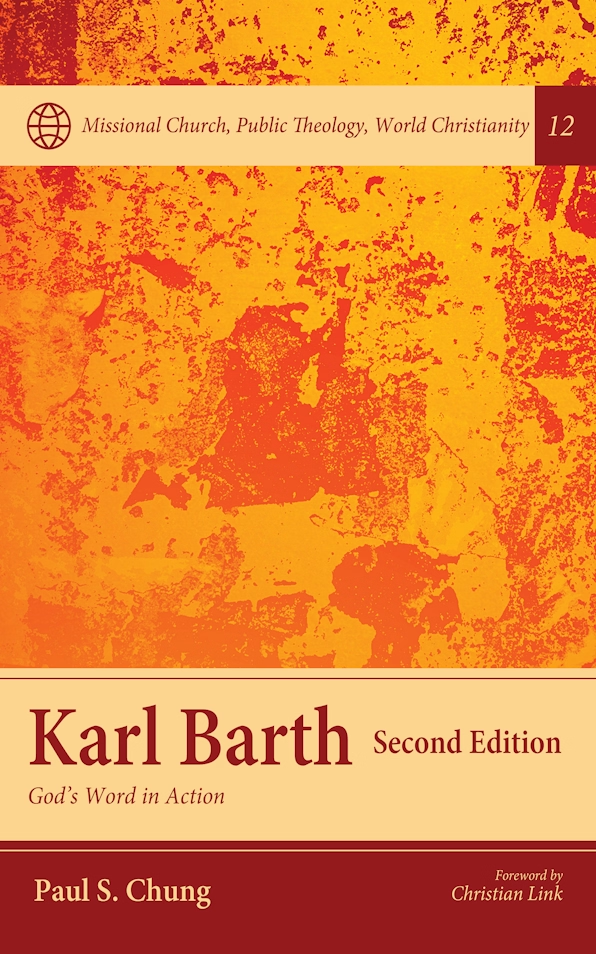
Paul S. Chung, Karl Barth: God’s Word in Action, 2nd Edition (Pickwick, 2026)
Paul S. Chung’s second edition of Karl Barth: God’s Word in Action represents a significant expansion and deepening of his earlier work, offering one of the most accessible yet conceptually rigorous introductions to Barth’s theological project available today. While the first edition provided a clear map of Barth’s theological landscape, the second edition presents a more textured, historically grounded, and globally relevant interpretation—especially for readers engaging Barth through public theology, science–religion dialogue, and comparative religion. Chung’s archeological skill of transposition is evident in his hermeneutical reconfiguration of Barth’s “forgotten side,” enabling readers to encounter Barth not merely as a historical figure but as a living voice in our century, inviting them into a deeper life‑field.
1. Strengthened Historical and Conceptual Framing
Chung situates Barth’s theology within its defining historical crises—World War I, the rise of National Socialism, and the collapse of European Christendom—while showing how Barth’s insistence on God’s Word in action remains a living paradigm for the twenty‑first century. The new edition clarifies Barth’s dialectical method, his Christological concentration, and his rejection of both politically misused natural theology and political quietism.
2. Concursus, Revelation, and Divine Agency
One of the strongest contributions of this edition is Chung’s treatment of divine agency. He presents Barth’s concursus not as metaphysical intrusion but as relational, covenantal, and world‑engaging divine action—a reading that resonates with contemporary discussions in science and theology.
A particularly original contribution is Chung’s retrieval of Barth’s largely forgotten engagement with natural science, evolution, and ecology. Developing Christian Link’s Bochum tradition in dialogue with the quantum physics of Carl Friedrich von Weizsäcker, Chung shows how Barth’s theology can be placed in constructive conversation with modern scientific paradigms—particularly systems biology and quantum field theory. This includes Chung’s own work on systems field theory, drawing on Weizsäcker’s time structure and Paul Dirac’s dynamic time variables in perturbation analysis to construct models of biological temporality, irreversibility, and punctuated evolvability.
Here Chung’s expertise is most evident: he interprets Barth’s theology of action through a modern scientific lens without distorting Barth’s core commitments. His current writing project, Public Theology and the Geometry of Life, is ambitious and creative, refreshing Barth’s proto‑autopoiesis thinking in encounter with ecological resilience and God’s presence in the natural world—articulated through concursus, Sabbath ontology, and divine eschatological healing.
3. Public Theology and Global Relevance
The second edition expands Barth’s relevance for public theology, especially in East Asian contexts and in interreligious engagement. Chung demonstrates how Barth’s theology resists both authoritarian political theology (Carl Schmitt) and privatized spirituality, offering instead a robust framework for justice, reconciliation, interreligious dialogue, and social solidarity within ecumenical public theology.
Chung treats Barth and Bonhoeffer as complementary figures for global public theology rather than isolating them. His engagement with Rousseau, social democracy, and critiques of bureaucratic governance shows how Barth’s theology can inform contemporary debates on inequality, democratic ethics, and the politics of recognition.
4. Readable, Structured, and Pedagogically Strong
The book remains highly readable. Chung’s prose is clear, his explanations patient, and his structure pedagogically effective. Students encountering Barth for the first time will find this edition far more accessible than most introductions, while scholars will appreciate the conceptual precision and expanded bibliography.
5. A Mature Contribution to Barth Studies
This second edition is not merely a revision—it is a maturation. Chung integrates decades of scholarship, teaching, and global engagement to produce a work that stands alongside the best contemporary introductions to Barth.
Overall Evaluation
Paul S. Chung’s Karl Barth: God’s Word in Action (2nd ed.) is a major contribution to Barth studies and to global public theology. It is historically grounded, conceptually sharp, globally relevant, and pedagogically accessible. For students, pastors, and scholars seeking to understand Barth’s theology as a living, world‑engaging paradigm, this book is indispensable.
Author on Public Theology and Science Council for East Asia
With the publication of this second edition, Chung hopes that the Forum Center will further develop a new platform for a public theology of science and systems field theory for East Asia, where creation science and genetic‑determinist sociobiology continue to shape civil society and academic discourse.
Barth’s theology of divine action—interpreted through relational concursus, ecological realism, and quantum temporality—provides a conceptual foundation for advancing interdisciplinary research on biological meaning, emergent life, and public responsibility in East Asia. This edition thus serves not only as a theological introduction but also as a launching point for the Center’s future work on public theology in dialogue with systems biology, quantum field theory, and comparative religion. Prof. Deborah Gordon of Stanford University and the Santa Fe Institute serves as senior advisor in this direction.