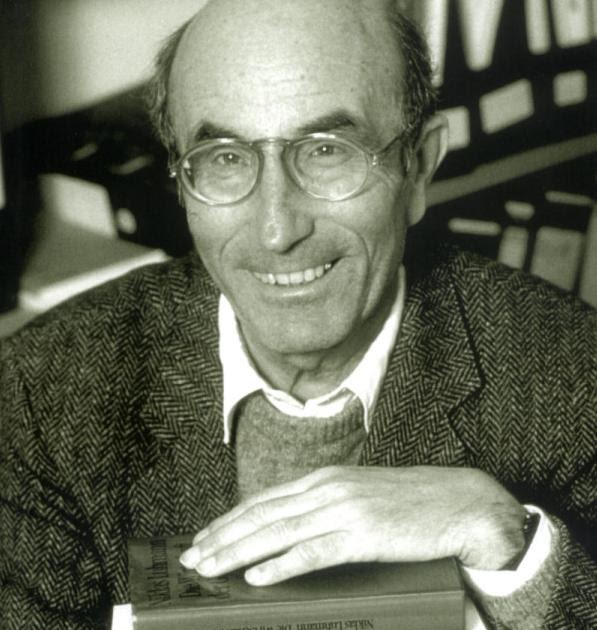
Self‑Referential Systems, Embodiment, and Public Theology
Abstract
This chapter returns to Niklas Luhmann’s theory of social systems and reinterprets autopoiesis through insights from embodied biology and epigenetic science. Building on the Santiago School’s account of living systems, the chapter develops an interdisciplinary reframing of autopoiesis. It places a public theology of science within cultural–linguistic contexts shaped by bilingual translation and intercultural communication. The chapter locates meaning, life, and social systems within a shared ecology of emergence, offering a basis for examining how embodied interaction, linguistic practice, and epigenetic responsiveness together shape the lifeworld.
Introduction
This chapter engages Niklas Luhmann’s theory of social systems and expands it with insights from Maurice Merleau-Ponty, Francisco Varela, and Ludwig Wittgenstein. These thinkers share a central insight: meaning grows out of embodied interaction rather than abstract representation.
At the neural level, autopoiesis shows how local interactions create larger patterns through coarse graining, a continual process that simplifies information and meaning. The nervous system functions as a network of shifting and dynamic connections. Each neuron shapes the spatial and temporal flow of incoming signals, and changes in one area spread throughout the system. This demonstrates how the system keeps its operational boundary and maintains its identity through its own internal activity.
My aim is to rethink the relationship between biological life and the lifeworld. I show how embodied interaction, epigenetic pathways, and linguistic practices create the relational structures through which meaning emerges.
Together, these elements shape an autopoietic form of the lifeworld—one influenced by language, meaning, and epigenetic processes that move across culture, society, and ecological systems. This structural view of autopoiesis, grounded in the geometry of life, responds to major critics of Luhmann’s systems theory, including Jürgen Habermas and Jean-François Lyotard. Habermas stresses rational consensus, and Lyotard highlights the postmodern condition, yet both recognize the importance of Wittgenstein’s theory of language. Wittgenstein’s framework provides an alternative social view of language networks, built on adjacence, creative bilingualism, and the generative power of shared practices.
Given this, I retrieve Husserl’s insight into the ecological form of life at a biological level and his contribution to the geometry of life, which underlies autopoietic phenomenology. Life is embedded within the epigenetic lifeline across biological and social ecological stratification.Within this horizon, a public theology of living systems is grounded at the intersection of science, society, and ecology, advocating for multilayered entities of meaning and forms of life. It understands life as emergent, embodied, and shaped within the evolving structures and stratifications of multiple realities.
Interaction in Neuronal Networks
Autopoiesis, from autos (self) and poiesis (making), describes how living systems sustain themselves through self‑organizing processes while staying open to energy and matter from their environment.
At the cellular level, autopoiesis refers to the dynamic autonomy that shapes an organism’s organization and allows it to generate its own world of interactions. Neuronal networks illustrate this dynamic clearly, showing how operational boundaries and structural coupling appear within living tissue.
Neurons transmit electrical and chemical signals across the nervous system, integrating inputs through the dendrites and soma before producing an action potential at the axon hillock. The axon carries this signal to the presynaptic terminals, where neurotransmitters are released to affect muscles, glands, or other neurons.
The difference between presynaptic and postsynaptic cells marks the direction of this communication. A neuron’s function is inseparable from its morphology. The collector region—dendrites, soma, and proximal axon—integrates incoming signals according to the neuron’s internal reference state, which reflects its history of interactions and shapes its response.
The distributive element, typically the axon, conducts the propagated signal toward the effector region, where neurotransmitters adjust the activity of target cells. Synaptic plasticity continually reshapes these interactions, altering patterns of connectivity and information flow.[1]
As neural networks evolve through these interactions, they generate emergent patterns of signals and communication that exemplify autopoietic organization. These patterns shaped by an operational boundary analogous to a Markov blanket, coupled with modular architectures and continuous response to environmental perturbations.
As Maturana and Varela note, “The nervous system can interact with the representations of its interactions (and hence, of the organism) in an endless recursive manner.” [2]
This recursive process shows how identity is preserved through ongoing self‑modification, revealing how living systems maintain coherence while staying open to structural change and emergent complexity.
Autopoietic Network, Rhythm and Meaning
According to semantic realism, meaning is the generative principle that shapes biological, neural, and social individuation. To understand the structure of neural cells, we need a conceptual framework for a meaning‑based theory of individuation—a semantic theory of individuality. For meaning to form an individuated entity within a neural network, several biological and dynamical processes are essential.
1. Chromatin remodeling
In neural cells, genes do not express themselves first. Gene expression is regulated by the opening and closing of chromatin. Genes are therefore not a fixed “program” but an open set of possibilities shaped by environment, experience, and neural activity.
2. Epigenetic modulation
DNA methylation and histone modification change gene expression in response to experience, learning, stress, and social interaction. Meaning is not a by‑product of genes; rather, gene expression is influenced by meaning‑laden processes.
3. Synaptic crossing
Genes do not produce neural firing. Firing arises from electrical, chemical, and network‑level interactions. As neurons fire, synapses transmit signals, connection strengths shift, and repeated patterns allow the network to self‑organize. Even if information is defined as the minimal unit of meaning, meaning remains the higher‑order principle. Synapses undergo billions of crossings, transmitting signals, filtering noise, and compressing patterns through coarse graining. In this process, seeds of meaning are generated and passed to adjacent cells. [3]
4. Attractor basin formation
When synaptic networks stabilize through repeated firing, an attractor basin emerges. Here, meaning arises in an explosive and emergent way, forming a Markov blanket that stabilizes identity and adjacency—something genes alone cannot accomplish.
5. Markov blanket formation
As coarse graining continues, natural boundaries form between self‑cells and other cells. This is the Markov blanket. Meaning generates boundaries, and boundaries generate individuated entities. None of this is the work of genes. Genes merely produce proteins, and even that process is regulated by chromatin remodeling and epigenetic modulation. [4]
From these processes, we can glimpse how life begins to move. This is where living systems reveal themselves—expressed and characterized in the rhythm of semantic realism.
Life opens through chromatin’s quiet breathing, where the genome loosens into possibility.Epigenetic marks gather the pressures of the world, bending the cell toward resilience.Across synaptic crossings, signals carve the first grammar of meaning, compressing experience into form. As patterns repeat, an attractor basin settles—a small gravitational field where the organism leans toward a new shape.
From this leaning, a Markov blanket forms, a soft boundary that lets the world in while holding a self together.Meaning threads these layers—chromatin, synapse, network, boundary—through which a living system becomes a world in its own right.
Autopoietic networks organize experience, weaving boundary, coupling, and coherence into the fragile architecture of a self. Cognition is never separate from the body; it is the body’s way of listening, touching the world and being touched in return. An autopoietic phenomenology begins here—in the living subject who feels, remembers, adapts, and through these acts becomes a world unto itself.
Living Systems and Social Systems
Francisco Varela integrates biological cognition with Merleau‑Ponty’s phenomenology of perception, emphasizing the embodied and enactive nature of life. In this view, living systems “bring forth a world” through the interaction of the network, the operational boundary, the systemic architecture of chromatin remodeling, synaptic crossings, and evolutionary drift. Cognition is not a disembodied process but arises through lived bodily engagement with the environment.
Knowing is therefore not something the mind does about the world but something the body does with the world. Varela’s neurophenomenology and its enacted cognition find their relevance in contemporary neurodynamics and the free‑energy principle of autopoiesis and structural coupling, in which information is self‑organizing and emerges as meaningful pattern.
While Varela did not mathematically formalize neurophenomenology in The Embodied Mind, contemporary neurodynamics—especially Friston’s free‑energy principle—provides the mathematical and informational framework needed to articulate enaction, autopoiesis, and structural coupling in terms of self‑organization, attractor dynamics, and Markov blanket formation.
Niklas Luhmann, by contrast, conceptualizes social systems as self‑referential networks of communication. Whereas Varela grounds cognition in embodiment and enaction, Luhmann locates autopoiesis in communicative operations that distinguish a system from its environment while remaining structurally coupled to it. Social systems reproduce themselves not through biological processes but through recursive communication. Both theories describe self‑producing systems, yet they operate on different planes—one biological, the other communicative.
The Santiago School’s autopoietic understanding of evolution highlights structural drift and the conservation of adaptation across an organism’s history. Symbiosis plays a central role in this process: mitochondria, chloroplasts, and even the nucleus exemplify how living systems evolve through cooperative integration rather than isolated competition.[5] Evolution here is not a battle but a long history of relational trajectories, preservation of boundary identity and innovation of life.
The past becomes the sedimented history of structural coupling—its conserved deep structures—while the future opens toward new interactions shaped by that history of interaction. This temporal doublet supports a post‑Darwinian account of evolution in which continuity arises from the conservation of autopoietic organization rather than from natural selection and competition for struggle.[6]
For Varela, embodied enaction means that the mind arises through the body’s ongoing engagement with its environment. This claim is grounded in Merleau-Ponty’s insight that the body is the primary site of knowing and being in the world. This body-subject explains why Varela’s world is a sensorimotor network—globally distributed and ecologically embedded—whereas Luhmann’s world is symbolic and communicative.
This differentiation is crucial for constructing a public theology of living systems. By integrating embodiment, enaction, and forms of life into systems theory, a relational‑emergent framework becomes possible—one that situates public theology within the lifeworld and its ecological, communicative, and evolutionary horizons. Public theology enters here because meaning, life, and society cannot be separated from the embodied conditions that generate them.
Such a framework rearticulates autopoiesis across biological, social, and linguistic domains, clarifying how living systems and social systems co‑constitute meaning within a shared ecology of emergence.
Scientific public theology understands the human being as a multilayered, meaning-bearing existence—a life-form with boundaries—and develops a life-theory in which meaning is continuously generated through rhythm and canalization within the attractor basin. It attends to nonlinear temporality, the philosophy of adjacency in mutual illumination, where systems reveal each other’s contours.
Through temporal structures, life brings forth meaning through punctuated transposition and the resilient renewal of form. In this respect, autopoietic phenomenology provides a conceptual framework for public theology, and the latter unfolds the field of meaning and life through structural coupling, the common good, and the politics of recognition for opening new horizons of creativity new creativity.
Embodiment, Language Network, and Public Theology
Phenomenological accounts—especially those of Merleau‑Ponty—emphasize the intercorporeal and intersubjective dimensions of communication. Social structures do not arise solely from abstract systemic operations but emerge through embodied interactions in which subjectivities are woven into shared practices, linguistic forms, and institutional arrangements.
Society is therefore built not only by systems but by bodies in relation. This orientation requires a theory of social structure that synthesizes self‑referential systemic logic with intercorporeality, foregrounding the embodied and relational emergence of the self within a social system. It reopens debates in systems sociology and critical theory: Habermas critiques Luhmann’s system–environment distinction, while Lyotard warns that systemic optimization marginalizes heterogeneity and plural language games. [7]
Their critiques highlight the need for a social theory attentive to difference, contingency, and communicative multiplicity. Both draw on Wittgenstein’s account of language games, which emphasizes rule‑governed public language and the forms of life that make meaning possible. This dethrones the autonomous subject and opens toward a condition in which meaning is inseparable from power relations and linguistic plurality.
In distinction from them, I reinterpret Wittgenstein through the lifeworld and the cultural‑linguistic network, emphasizing embodiment, linguistic intentionality, and the semantic circle. Meaning arises not from a disembodied mind but from lived bodily engagement with the world—rooted in pre‑reflective experience prior to rationality or the ideal speech situation. A structural theory of autopoiesis must therefore integrate linguistic intentionality and the semantic circle with Wittgenstein’s insights into public language. Language games operate within relational emergent networks that bring forth meaningful forms of life, highlighting translation, conceptual bilingualism, and semantic resonance for a public theology of science.
To enrich the science–religion dialogue, I propose a bilingual model grounded in Wittgenstein and Kuhn, moving beyond the “two‑language” paradigm[8] by recognizing cross‑paradigmatic translation and emergent meaning across scientific and theological discourses.
In the phenomenology of perception, Merleau‑Ponty understood the body as the primary site of cognition. I take this one step further: perception occurs as the body comes into contact with the world and undergoes a process of stabilization within consciousness. This living stabilization can be understood through the attractor basin, which provides the methodological orientation of the geometry of life. Phenomenological reflection, through epoché, continually returns to this primordial site as a genealogical movement—yet Merleau‑Ponty did not fully develop this trajectory.
In the public theology of living systems, linguistic suspension denotes the moment in which the body‑subject opens toward the world—a living pause before meaning emerges. It attends to the ecological transparency and the complex rhythms of life that precede linguistic capture. Oriented toward the primordial site where speech rises from life itself, linguistic suspension gestures toward a new configuration of time, enacting meaning within the attractor basin where the body‑subject perceives the world and brings it forth.
Autopoiesis, Geometry and Lifeworld
Varela and his colleagues reinterpret Husserl’s concept of the lifeworld as articulated in The Crisis of European Sciences. For Husserl, consciousness is always situated within the lived world—the everyday horizon that grounds meaning, validity, and truth. All theoretical reflection, including scientific inquiry, presupposes this lifeworld as its background structure. Husserl sought to reorient science by recovering the lifeworld as the sedimented foundation of preunderstanding that makes cognition and culture possible. The lifeworld is the soil from which all knowledge grows. The rise of the “Galilean style” of mathematized science, however, eclipsed the lifeworld by abstracting from embodied experience. Varela and his colleagues, drawing on Heidegger and Merleau Ponty, conclude that Husserl’s project remains incomplete.[9]
In this context, I reinterpret Husserl’s phenomenology not merely as a critique of Galilean mathematization but as a historical‑cultural project aimed at recovering the generative meaning of life, world, and knowledge.
For Husserl, geometry possesses an ontic meaning, one that originates in a concrete accomplishment—first as a project and then as its successful execution—and is subsequently accumulated through the ongoing progress of knowledge. The process of projecting and realizing a scientific construction occurs entirely within the personal sphere of consciousness. Through this accomplishment, what is constituted becomes something that exists objectively—something “there for everyone.” Husserl calls this an ideal objectivity, to which both scientific constructions and the sciences themselves belong. Galileo, however, eliminated this generative meaning by reducing geometry to a purely mathematical idealization.[10]
Merleau Ponty’s Phenomenology of Perception remains deeply indebted to Husserl’s account of the lived body in Ideas II. When extended into biological and ecological domains, Husserl’s late writings reveal a striking turn toward biology. In the later sections of Krisis, he begins to treat biology not merely as an empirical natural science but as a primordial science of life—a discipline capable of uncovering the generative structures of the lifeworld itself.
For Husserl, life is given in its most original and proper mode through the self-understanding of living systems. This insight provides the guiding thread for biology as a whole: the human being possesses a biological a priori and, through empathic participation, experiences every transformation of living beings. Organic life, in this sense, carries the ultimate meaning of constructing a whole from its parts. It unfolds within the structural horizon of an Umwelt—a world of the living—whose ontology is complex rather than simple.
The world of living beings is vast, incessant, and close to the source of evidence; it belongs to the descriptive regime of phenomenology. Biology, like physics, shares the universality of the same world, yet it is grounded in the primordial formation of meaning within the lifeworld. Biology not only presupposes this generative horizon but also participates in its ongoing accomplishment.[11]
In this respect, Husserl’s Origin of Geometry becomes the geometry of living systems: through the capacity for reactivation, the accomplishments of life are recorded, sedimented, and renewed, revealing the transformations and evidential clarity of life’s meaning-formation. This process accompanies the genesis of deductive sciences and discloses essential modes of being that underlie their universal structures.
From this standpoint, my geometry of life develops a semantic realism in dialogue with systems biology. Through chromatin remodeling, epigenetic resilience, the boundary identity of the Markov blanket, and the stabilization of attractor basins, living systems canalize new forms of life and disclose emergent universal laws. These laws arise through multi-layered connections across science, sociology, and public theology, forming an interdisciplinary framework for understanding life’s generative meaning.
What is particularly intriguing is that Husserl, who consistently described God as the wholly Other in a manner reminiscent of Barth, nevertheless held Spinoza in exceptionally high regard. His admiration was directed toward his rigorous attempt to articulate the geometric order of being, meaning, and ethics as a systematic account of ontology.[12]
Furthermore, a Husserlian position appears closer to David Bohm’s scientific ontology. If quantum theory understands the universe as a complex web of relations within a unified whole, this suggests that quantum field theory operates through the distinctive interplay between the implicate and explicate orders. This interplay is mediated by nonlocal hidden variables—active information—that guide the cosmic course of evolution and its implicit life. It bears little resemblance to the Eastern mystical notions of mutual dependence or emptiness, contrary to Capra’s interpretation.[13]
At the phenomenological level, the lifeworld becomes not only the horizon of human meaning but also the matrix in which biological life enacts its own relational coherence, structural coupling, and adaptive emergence.
Systemic Form of Life and Epigenetic Discourse
A structural theory of the lifeworld allows us to move beyond the reduction of “system” to impersonal institutional forces—such as the state, market, or media—that Habermas critiques for colonizing the lifeworld. I employ “lifeworld” instead to denote the deep structure which includes not only social meaning but also biological and ecological processes. Luhmann’s systems communicate, but they do not live; they lack the embodied grounding that lifeworld theory restores.
If self‑referential systems “bring forth” their world in the enactive sense—analogous to Wittgenstein’s notion of a form of life—then each system constitutes its own form of life, embedded within multiple realities and realized through embodied interaction and epigenetic resilience to socio‑ecological conditions.
The epigenetic landscape cannot be excluded from discussions of biological life. It provides the cellular framework for chromatin biology and reveals how social stratification—such as socioeconomic status, race, and chronic stress—affects health by altering gene expression through histone modification and DNA methylation. Epigenetics shows that social inequality literally writes itself into the body.
These changes influence chromatin regulation, cellular metabolism, cognitive function, and susceptibility to age‑related disease. Social disadvantage thus becomes biologically sedimented, shaping resilience, plasticity, or pathological decline in an organism’s structural coupling with its environment.
Life is never reducible to biology alone; it is always biosocial, sedimented through the social, cultural, and ecological horizons that shape embodied existence. Cognition generates a field of behavior through enactment within the historical trajectories of interaction rather than through representation of an independent universe. The organism constitutes a meaningful niche through structural coupling, relational emergence, and adaptive responsiveness.[14]
When structural changes become excessive that the system can no longer sustain the organization and its coherent boundary of identity, autopoietic unity collapses and the organization ceases to be actualized.[15]
The structural framework of interaction advances an autopoietic theory of semantics within the lifeworld constellation—a web of signification embedded in epigenetic lifelines that traverse culture, society, power relations, and ecological systems.
The lifeworld constellation functions as an overarching framework that encompasses history, society, science, and culture as sources of meaning, immanent critique, and emancipatory possibility. At the same time, the epigenetic lifelines within stratification become an object of bio-sociological investigation, illuminating how socio‑ecological forces shape biological life by influencing resilience, plasticity, or pathological decline in an organism’s structural coupling with its environment.
Meaning and discourse are inseparable from social inequalities and power relations, which bear biological consequences that can be transmitted across generations. Language is not merely spoken; it is lived. Communication is not a neutral exchange of information but a socially embodied practice shaped by rules, norms, and cultural codes in linguistic network. Communication is already embedded within structures of stratification—such as inequality, racism, gender, and systemic power dynamics—that leave biological traces through epigenetic pathways underlying language network.
A language‑game framework, when treated in isolation, tends to bracket structural coupling with adjacent language games and with the socio‑ecological environment. Language without lifeworld becomes a closed echo chamber. Such neglect weakens the autopoietic capacity of self‑reference for bricolage—its ability to creatively recombine elements during structural drift.
Here, public theology of living systems and a semantic theory of realism converge into a metatheory of the autopoietic lifeworld—one imbued with epigenetic resilience as well as socio‑cultural stratification which is captured in terms of Markov blanket, attractor basin and punctuated creativity under proleptic horizon fluctuating within the vivid present as ontological constitution of time-meaning.
At the cultural level, language arises from natural expressive behavior and learned orienting interactions that embody functions of non‑linguistic origin. These functions evolve through systems of cooperative, consensual interaction among organisms, revealing language as an emergent property of embodied social life.[16]
Within this communicative network, fixed denotation gives way to social use and functional context. Naming an object may be one aspect of a language game, but meaning is never a one‑to‑one correspondence between word and object. Meaning is constituted by public, rule‑governed practices and cultural codes—by the lived, embodied, and socially mediated forms of life in which language is enacted.
Coda
Meaning arises within the embodied, relational, and historically sedimented lifeworld in which living systems enact their world through structural coupling, adaptive response, and boundary identity. The lifeworld is the deep structure that binds the semantic, ecological, and cultural dimensions of existence, shaping how organisms and societies bring forth a form of life through their ongoing interactions. Autopoiesis illuminates this dynamic by showing how living systems maintain their identity through operational networks while remaining open to external irritations that reshape their developmental configuration.
This interplay of boundary conservation and openness grounds the conditions for meaning, resilience, and transformation through processes of stabilization and attractor formation. In this sense, the lifeworld constellation becomes a semantic ecology—an interwoven field of biological, social, and cultural processes that co‑constitute one another across multiple realities.
Within this constellation, language is not merely a symbolic system but an embodied practice rooted in forms of life. Meaning is enacted through public, rule‑governed activities that reflect an organism’s biological history, social environment, and cultural horizon. The semantic circle links embodiment, intentionality, and linguistic expression within the proleptic horizon. It shows how meaning arises from the interplay between the pre‑reflective experience of the lifeworld and the shared practices of daily life that constitute time as vivid present, acknowledging diverse provinces of life, temporality, and world in a generally relative manner. This perspective opens a path for public theology to engage science not as a competing discourse but as a structurally coupled partner for mutual clarification within a shared world.
Science and theology become bilingual modes of meaning‑making, each contributing to the articulation of life’s character. Their interaction forms a creative space in which new semantics can arise—capable of addressing ecological vulnerability, social inequality, and the evolving dynamics of epigenetic lifelines and modulation. In this way, the life‑field becomes a site of both critique and hope. It discloses the deep structures that shape meaning, entangled with material interests and power relations across a broader spectrum.
Scientific public theology concerns possibilities for renewal through relational emergence, epigenetic resilience, and communicative transformation. The task of public theology, then, is to participate in the ongoing articulation of life within the autopoietic system—to interpret, translate, and reconfigure meaning, the common good, and the innovation of life within the evolving world and the geometry of life.
[1] Henley, Foundations of Neuroscience, 5-6, 15.
[2] Ibid., 25.
[3] Freeman, How Brains Make Up Their Minds, 25-48.
[4] Friston, “Life as We Know It,” Journal of the Royal Society Interface 10, no. 86 (2013): 1-14.
[5] Margulis, Symbiosis in Cell Evolution.
[6] Maturana and Valera, The Tree of Knowledge, 124.
[7] Lyotard, The Postmodern Condition, 47.
[8] Barbour, When Science Meets Religion, 19.
[9] Valera, et al. The Embodied Mind, 15-20.
[10] Husserl, The Origin of Geometry, in Derrida, Introduction to Husserl’s “Origin of Geometry.” 159–160,
[11] Husserl, Die Krisis der europȁischen Wissenschaft und die transzendentale Phenomenologie, Vol. VI. Beilage XXIII.
[12] Ibid., §11.
[13] Capra, The Tao of Physics, 138.
[14] Maturana and Valera, Autopoiesis and Cognition, xvii-xviii, 49.
[15] Ibid., xx.
[16] Ibid., 31-2.